 Keith Bartholomew
GorettiFest: The Movie(s)
How do you convince a community to care about a festival they’ve never seen? “Make a movie” was my answer. I’ll share the videos with you first, and then tell you the story of how they came to be.
GorettiFest 2024
This is the result of my first ever attempt at making a video of this size and scale. It’s obviously wanting for quality in some areas (mostly lighting and color grading), but overall is still something I’m very proud of.
GorettiFest 2025
Sophomore slump? I don’t think so. I put more effort into the interviews this year, because that's where the story really takes shape. Hearing from more people definitely gave the story more depth, and I think my extra technical investments (real lights! better lenses!) were very effective at making the story itself shine without getting in the way. I also had more help from other passionate volunteers to collect drone footage and do "man on the street" interviews.
Behind the Scenes
In the fall of 2024 when I helped launch the GorettiFest website, I was also involved in various aspects of the event's planning committee. In many of our meetings, we kept struggling with the problem of how to convince the community (a bunch of strangers) that this festival they've never heard of was actually going to be as fun as we said it was. It had never been this big before. We barely even had any high-quality pictures of what it was like before.
Thinking ahead, I realized that the only time to gather promotional material for future years’ festivals was during the current festival, and that was coming up quick; we were about one month out at this point. So I raised my hand and said, ”We should really have one or two people dedicated to taking photos and videos of GorettiFest so we can promote it better next year. That should be their full-time job during the festival.” I was thinking they would hire somebody. Instead, the organizer looked straight into my eyes and said, “Yes…yes, somebody should do that.” After a short staring contest, I realized that I was that somebody.
I’ve always had a hobby-level interest in photography that I trace back to a summer road trip in high school when all I had to occupy myself were a film SLR camera, its manual (essential), a manual-focus lens, and a few rolls of film. Give me something that requires technical mastery and I’m hooked! Recently, I had been volunteering my services to take photos to market the school, so the idea of taking photos of an event like GorettiFest was really not a big deal. But I had bigger plans than that.
For some reason, the moment I hatched this “photos (and videos)” idea, an idea entered my head that I just couldn't let go of: This needs to be a documentary. I was witnessing the excitement, the build-up, the anticipation, and felt that we would be missing a huge opportunity not to share that with the world. GorettiFest is great, but if you just show up during the weekend and go home you probably miss all the hard work that went into it and the people who made it happen. I was confident that there was a compelling “behind the scenes” story to tell and set forth planning how to tell it.
Gear Acquisition Syndrome
I wanted to start small, so my initial plan was just to use my iPhone to film things. My Amazon purchase history from this time is like watching a snowball roll downhill:
- I knew that I would need a few extra tools to make the footage look reasonably professional, so I bought a phone cage and some handles to help get a more stable platform.
- Audio makes or breaks videos (and I also have a hobby-level interest in audio engineering) so I bought a shotgun mic that could connect to the iPhone via its USB-C port.
- I bought a boom pole for the shotgun mic, based on some delusion that I would train a volunteer to be a boom operator and get them to walk around with me capturing field audio. I never used it, but it is fun to play with!
- I realized that I would not always be right next to my audio sources and would need some wireless “reach”, so I bought a wireless audio set that also doubles as a pair of wireless mics and field recorders.
- 4K video footage takes up a ton of space, much more than what was available on my phone’s built-in storage. So I bought an SSD.
- Now that I had multiple accessories, I also had to buy a USB-C hub for my iPhone’s single USB-C port.
- After a few days of testing everything out, I found that recording video non-stop uses a ton of battery, so I bought a power bank (which has since been recalled for fire risk…😬)
- Getting good motion blur is really important for the "cinematic" look, but hard to get when you’re out in direct sunlight, so I bought an iPhone case that supported a common 67mm filter thread and a variable ND filter. Uh oh, we're entering the “real” camera world now.
What started as ‘just my phone’ slowly turned into a realization that I was treating this like a real film.
After collecting some initial footage, I still wasn't happy. The iPhone camera sensor is great for what it is, but optically it's just impossible to get the kind of depth of field (AKA: blurry background) that you can with larger lenses and sensors. As I refined my vision for the project, I was sure that I would have to work really hard to jump beyond the “amateur” look. I had been doing tons of research (AKA: watching YouTube videos) and realized that I was legitimately hitting a case in which I had outgrown the tools I was using.
I caved and decided to buy a popular and very well-reviewed, entry-level “cinema” camera, the Sony FX30. Oh and of course memory cards, a cage, spare batteries, a top handle, external monitor, batteries for the monitor, and a dedicated camera backpack to hold all my new toys. Luckily, most of the accessories I had bought beforehand were still useful with a “real” camera.
Now I have a solid, professional-grade set of tools. All that's left is to use them correctly.
Three Places at Once
GorettiFest is a big event, with lots to do all weekend long. This is great for our guests, but maddening as a newly-minted videographer who's terrified of missing any big moments.
Before the festival, I went to every setup and prep event that I possibly could, just to capture footage. I organized documentary-style interviews with the event leadership. Unfortunately, I interviewed some of them before the event actually happened so a lot of what they had to say was just, “I hope it’s going to be great!”
During the festival, I ran from place to place as much as I could, always on the lookout for interesting things going on. Never underestimate the value of good B-roll! However, I also had to take photographs of the event, so in addition to running around the fairgrounds I also had to run back to my work station, put down all the video-oriented gear, and head back out with my photo-oriented camera to capture the same things in higher-quality still photos. When the sun was in favorable spots, I also had to put down those cameras and prepare my drone for some aerial footage to mix things up.
Being heavily involved in the general planning of the event, I also got roped into helping our team with a lot of non-video-related tasks simply because I knew where things should go or how they should be.
One of the most challenging aspects of gathering this footage was my fear of being in the way. GorettiFest is obviously not a movie set, and most of the places you’d need to put a camera for the perfect shot are also the places where a volunteer needs to work or a guest needs to walk. I’m sure I could have been more assertive and confident in briefly inconveniencing somebody to get the shot, but I definitely missed some opportunities because I was too timid. Also consider that nobody had any idea of the scale of the project I was working on, so I was effectively just a dad with a camera. Better play it safe.
The Editing Room
I was not prepared for how difficult it is to edit a documentary out of thin air, especially one as lightly-directed as mine. I've since learned that many documentaries are more scripted than you'd think; the directors will often instruct their subjects to do specific day-in-the-life activities for the purpose of re-enactment or telling their story. I had three unscripted interviews, hours of B-roll, and a blank slate.
Luckily, the story I wanted to tell was pretty straightforward: GorettiFest is our fall festival, we're making it bigger than ever, here's how we did that. Little by little, I started finding common themes in my interviews and stitching them together to craft a coherent story. There were a few specific topics like the helicopter landing and the alumni events that came together naturally. For the rest, I had to get comfortable assembling a unique dialect of documentary-style dialog, in which lots of tenuously-related phrases are stitched together to make a point that’s authentic to what the speakers actually said, but that they probably took several minutes to work through.
I used a montage. Lots of documentary people will call it a crutch, but hey…I have a lot of B-roll and I need all the help I can get.
I discovered the fun (and frustration) of finding royalty-free background music. Getting the vibe right was challenging. Is this a feel-good story, or a wistful one? In some cases the music drove the mood of scenes, which was a helpful way to guide the editing process. I found myself spending hours listening to different tracks with my eyes closed, trying to imagine, “If I edited a scene to this music, what would that look like?”
Controlling the pace was also an important challenge. I had a pretty slow, thoughtful tone in mind—I enjoy those artsy movies where you have a lot of time to reflect on what a character is feeling. My fellow organizers wanted a more upbeat, promotional pace. We were both right in a way. After watching your own edit dozens of times, you can get desensitized to how fast or slow something feels to a first-time viewer. I found that it was important to routinely step back and evaluate my own work from different perspectives and to challenge my own ideas about what was working well and what needed more attention.
The Premiere
One thing Matt (the lead GorettiFest organizer) was dead set on was that we were going to show "The GorettiFest Movie" in a real movie theater. He wanted to make a big deal of it, and make the premiere its own special event that people would get excited about and remember for years. I even made a movie poster:
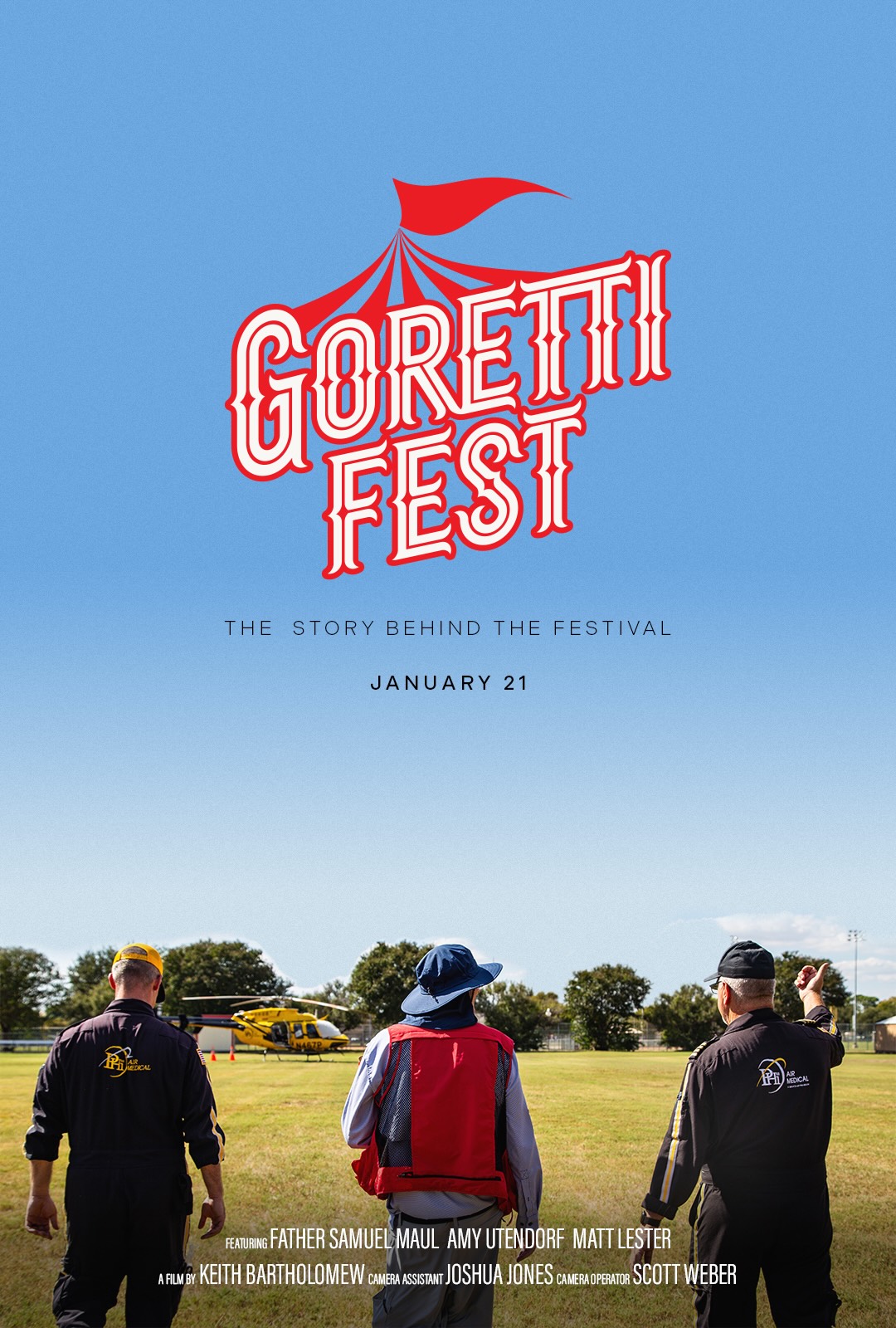
It was January of 2025 by the time we got the theater reserved and a date coordinated with the school. I had been done working on the movie for a few months. I was mentally finished with it, satisfied that I had tweaked every detail that mattered. All that was left was for people to actually see it.
As I sat down with 100 other people, there was a strange mix of peace and self-doubt—asking them all to stop for 15 minutes and watch something that took me hundreds of hours to make:
In the end, I think they enjoyed it. I don’t think they fully understood the attention to detail I put into every tiny aspect of it, but I think they enjoyed it. My mom came to watch it, and apparently the desire to show off your talents to your parents is the same as an adult as it is when you’re a kid.
The Sequel
To this day, I’m still happy with the first GorettiFest movie, but I knew there were things I could have done better. The story (whatever it ends up being) will be different every year, so I was excited to start working on the sequel.
One of the new tasks I had in 2025 was to use all of the prior year’s footage to make promotional videos for the school’s social media accounts. This was a challenging new exercise, where ultra-fast edits and eye-catching graphics are essential to getting viewers’ attention. Also, cropping horizontal video for a vertical video world is pretty tough.
This year, I made a bold decision to record all of my "day-of" footage vertically. In the context of the movie, it just looks like iPhone footage, but I'm hopeful that it will make next year's social media production a lot simpler. In hindsight, I don't think I liked this experiment. Call me old-fashioned, but my brain is wired for horizontal video. I found it really difficult to see and frame shots with my camera turned on its side, and I worry that I missed a lot of shots because I just couldn't figure out how to capture it vertically. Who knows, maybe it's a skill that I can work on.
I brought my iPhone and its camera cage (see, I did end up using it!) with the plan of maybe letting my daughter run around and "help" by capturing some B-roll. One of the students found my phone setup and wireless interview microphone and became obsessed with the idea of interviewing guests and talking to them about GorettiFest—he was also really good at it! It wasn’t part of my plan, but I ended up spending a huge chunk of both days walking around the festival with him, just holding the camera while he interviewed everyone he could find. It’s honestly the best content in the movie. I laugh at the irony that I left thousands of dollars worth of professional cameras and lenses sitting in a bag while I wandered around with just an iPhone and a wireless mic.
I made another movie poster:
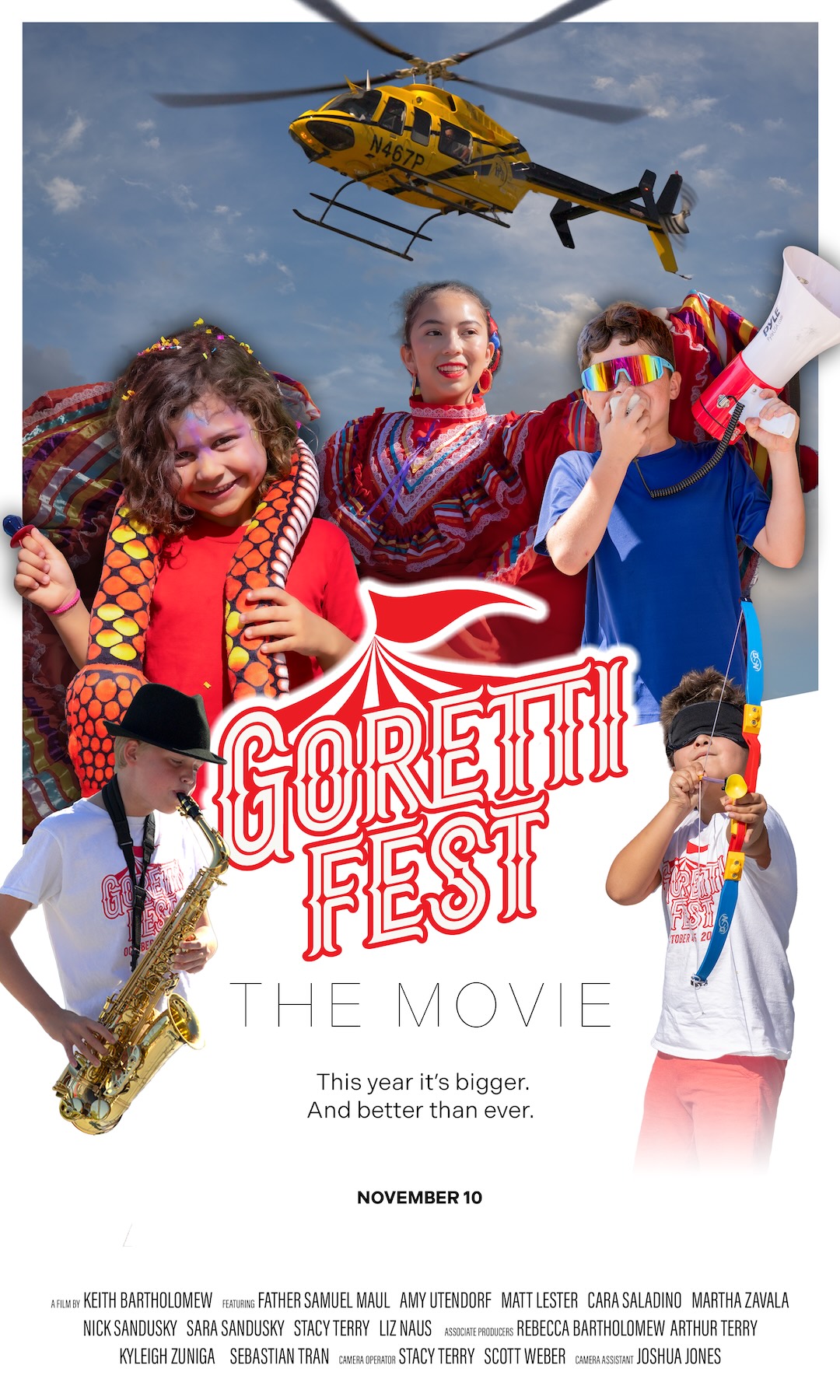
The weird feeling of 100 people watching something you made didn't go away, but I was definitely more self-confident about what I had produced the second time around. The story had changed. The doubt of “will GorettiFest even work?” was gone. The community rallied behind the event, and discovered things about themselves and their community that they might have taken for granted before. I found inspiring stories and shared them in a sincere, heartfelt way:
My mom came to watch it again, and I think she’s still proud of her son, who is apparently a filmmaker now.